Empowering Intersex Persons in Kenya: Insights from the IPICC Meeting on 2022 August Election Observation
A. INTRODUCTION
The Intersex Persons Implementation Coordination Committee (IPICC) was appointed to coordinate the implementation of the recommendations from the final report of the Taskforce on Policy, Legal, Institutional, and Administrative Reforms Regarding Intersex Persons in Kenya. IPICC is responsible for coordinating prioritized strategies and plans, assisting in the formulation and dissemination of recommended policy measures, developing relevant tools and information for advocacy, coordinating and facilitating collaborations, building the capacity of various stakeholders, and implementing recommendations.
B. BACKGROUND
The meeting was called to take stock of election observers' experiences during the monitoring of the concluded general elections and to deliberate on how best to harness efforts in the future to create more such opportunities for intersex persons. Participants included members of the IPICC Secretariat, the Kenya National Commission on Human Rights (KNCHR), and observers who monitored the general elections.
C. INTRODUCTION TO KNCHR/IPICC
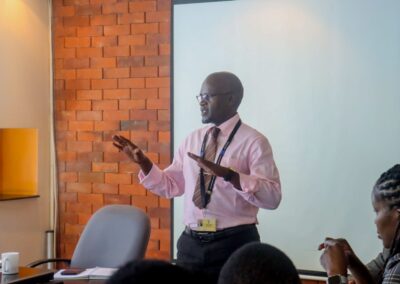
Dr. Amos Wanyoike discussed the role of KNCHR and IPICC in promoting and protecting the rights of intersex persons. He highlighted the work that has been done by the commission and the formation of IPICC and its key partners.
D. OPENING REMARKS
Commissioner Dr. Dennis Wamalwa recognized the presence of all persons present and pledged support to the IPICC and its Secretariat. He advised intersex persons to be assertive, speak up, and protect themselves as security and sensitization start with them.
E. EXPERIENCE SHARING
Vivviene Eyase facilitated the experience-sharing session where intersex persons who observed the elections shared their experiences. The points drawn from the experiences shared included ignorance of IEBC clerks on matters intersex, lack of information on intersex among security personnel, conflicts between legal documents and physical characteristics, and the support received from monitors and observers from KNCHR. In short, below are the findings from the task force;
- Ignorance of IEBC clerks at the polling stations on matters intersex despite being trained led to fear to vote as they were asked questions followed by tantrums.
- Some of them faced no challenges as they voted at polling stations they are known by people/ where they reside.
- Security personnel lacks information on intersex and therefore need awareness creation.
- Some due to conflict between their legal document (ID) and their physical characteristics, leading to them not voting for example when signing their names as agents.
- Some of them attested that their legal document (ID) and their physical appearance were matching as they have undergone the name change process successfully and therefore they had no challenges in carrying out their mandate as observers.
F. WAY FORWARD/ACTION POINTS
Action points were discussed, including preparing in advance for future election monitoring, creating awareness and sensitization for IEBC clerks and security personnel, and providing support to intersex persons during the election process. The importance of advocating for intersex rights and building partnerships with relevant stakeholders was also emphasized.